Selected Recording
"Bhairavee-Thumree" in ṭhumrī style in rāg Bhairavī and in tīntāl.
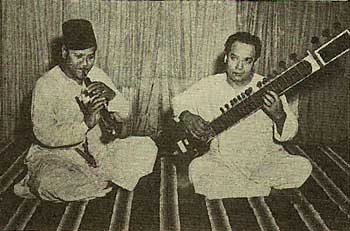
Ustad Vilayat Khan (sitār) and Ustad Bismillah Khan (śahnā'ī) with Pandit Shanta Prasad (tablā)
Duets from India (Capitol ST 10483).
An instrumental duet (jugalbandi) for the sitār and śahnā'ī (oboe).
Ustad Vilayat Khan's virtousic sitār technique finds a challenge here in Ustad Bismillah Khan's melodic śahnā'ī's abilities. Here, Vilayat Khan must work with the sitār's inability to sustain against Bismillah Khan's ability to make the śahnā'ī's tones swell, bend, and linger seemingly forever. (Bismillah uses circular breathing to hold tones indefinitely.) Vilayat responds by pulling the strings, subtly working the string, and playing to the instrument's strengths.
The śahnā'ī has special associations with weddings where a traditional celebration would include this oboe with kettledrums. In the absence of these musicians, parents often play this recording to bring the śahnā'ī's auspicious sound to the occassion.
The performers here only claim that this performance is in the style of a ṭhumrī, suggesting that the rāg and its articulations are more important than the formal elements.

     
Time Section Description
0:00 Ālāp Following standard ālāp structure, the sitar and the śahnā'ī systematically explore the rāg's possibilities.
  Ṭhumrī bandiś Functioning much the way a gat-toḍā performance would, the sitār and śahnā'ī take turns improvising in the rāg, returning to the sthā'ī each time.


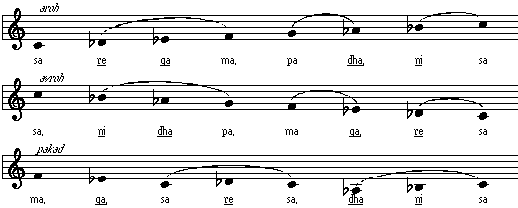
RAG BHAIRAVI
Rāg Bhairavī is described as an early morning rāg. Although the notes prescribed for Bhairavī are those of Bhairavī ṭhāṭ, in ṭhumrī and other light-classical renditions all the alternate notes are sometimes employed (bārā svar Bhairavī "twelve-note Bhairavī). Bhatkhande (1970, 2:391) gives the vādi of Bhairavī as madhyam and samvādi as ṣaḍaj, although he observes that some master artists make dhaivat the vādi and gandhār the samvādi.

Thumri Outline Bade Ghulam Ali Khan
  19 April, 2018